Brenna M. Hicks is a child therapist who blogs about common mistakes that parents make and explains children's behavior. Her article 10 things not to say to your kids makes complete sense, but unless you read it they are things you don't really think about. I am not a mom yet, but I became a co-parent with my other two sisters after my mom died for our three youngest so I have had experience. I think the thing that I used to do which I can tell never worked was the wait until dad gets home (#4). It took sometimes, but we (me and my sisters) stopped that when we realized it didn't work and made the less responsive. Brenna explains that because it is a threat and making the children fearful you are breaking trust. It is better to ask it they wanted to tell by themselves or if they wanted to do it together. So they don't escape the consequences, but can still trust you and you show that you respect the.
Friday, October 5, 2012

Wednesday, October 3, 2012
So my dad is getting divorced
I wrote the last entry a while ago and that was then that I was at my most hopeful that things would work out. But sometimes these things just don't work out. I a little resistant to the idea that they should get divorced, but I came to a conclusion: They aren't good for each other any more. They weren't helping each other grow. They were holding each other back. I wish the best for RaLyn, but it just isn't with my dad. It is a funny positively neutral feeling tied all together closure and...I guess the word is peace or ease...no something between that.
Wednesday, July 11, 2012
We were talking about blended families today and I ended up getting up and drawing it on the board. It made me think of what I include as family. |
| First I have myself |
 |
| I just got Married in November so I have started my own family |
 |
| I have my Dad and Ralyn as well as Cindy and David as my in-laws |
 |
| Originally my family was just us four |
 |
| We've grown a bit. So for those who are keeping count 4 sister in-laws (three my husbands sisters which is all of his family besides parents), 2 brother in-laws, 1 best friend, 3 biological siblings, 3 adopted siblings, 3 step siblings in the picture and 3 step siblings out of the picture, 1 sister in-law and 5 (1 in heaven) parents not in this picture . Grand total of 25 in my family, 14 in my immediate family with out marriages, 10 more added on because of marriages and 1in heaven. Yes, it is complicated to answer questions about my family.
One of the hard things is not understanding where you place is. It is easy to get lost in such a big family, especially when we all have so much baggage to go with it. I really worry about my family. I worry it wont work when I despicably want it to. We talk of the statistics of a blended family and that half the time they don't make it. It been 2 years since they got married and things have been crazy. It felt good to hear in class that blended families should 1. wait at least 2 years for normalcy (mine might need a bit longer) 2. have bio parents do the heavy parenting (which is done) 3. make step parents more like a good uncle or aunt (getting closer on that) and 4. conferencing together ( think this is getting better but really I don't know because I am not part of that. Which is how it should be). Really we are on the right track our track just happens to be more like a hot wheels race track than a train track. But that is okay, it doesn't mean we can't be a family or that we won't make it. It just means more work.

VS

|
Monday, July 9, 2012
Parents have ears too

There is something to be said of a good listener no matter what your age and who you are. When you are with someone who listens well you feel validated and appricated and what to be closer to them. It is a good thing we have ears. Doctor Popkins points out the errors that some parents make by being passive listeners and instead of addressing the needs of their teenager they
1. Be a know-it-all/lecturing ( here's what you don't know)
2.interrogate (why did you do that? when? where? how?)
3. command ( you will do this)
4. use sarasm (yeah....that'll work *not*)
5. give advice ( advice is good as long as it isn't something you are just saying to say like if you teen comes in and says I am tired you don't just say " well them you should get to bed earlier to keep your body healthy and strong")
6. have negative expectations ( don't worry you wont make it anyway)
7. psychologize them ( how does that make you feel?)
8. focusing on mistakes ( its just like this time that you didn't do what you were supposed to)
9. moralizing (when I was a kid we had better morals than you do now)
Really listen to what the person is saying, listen to their tone and body language. When you ask "how are you doing?" and someone says "fine" that doesn't mean that it is fine unless their tone and body language said so as well. I know that I have used these before on people I am talking to and I am not even a parent yet. I fall under 1,5 and 7 most of the time, but when we recognize that these are weaknesses we have we can better prepare to listen to our kids (or friends or co-workers or whoever) and instead of being great responders.
Thursday, July 5, 2012
Fatherhood

 These are the fathers in my life right now. To the left is my father, to the right is my father-in-law. Some people wonder if fathers are necessarily or if mothers are enough or if parents are needed at all. I would say YES! We need our Dads. Fathers help us to Build confidences by giving us a chance to fail in a safe environment, Communicate in that they help children expand linguistically, Disciple is focused on following rules and fairness, they prepare children for
the real world in that they focus on the consequences of actions in future life. Give a look into the
world of men in showing both boys and girls how men should act and treat women.
I remember being terrified of driving
outside of the lines. I would stare at the road just three feet in front of my
bumper and wobble the car back and forth trying to keep in perfectly safe and I
usually hugged the white line because I was scared of oncoming traffic. On one
of these drive to a work site the road was very narrow curvy and downhill
dissent with a sheer drop on the right side of the car. Dad was having me drive
and I was freaking out about it. Finally at a straight part of the road he told
me to cross over the middle yellow line, when I thought I was their he told me
I wasn’t even close. He then had me drive into the other lane and back again.
He had me do this until I could touch both lines on either side of the road
comfortable and understood where the car was actually at. He told me to look
into the distances and not so immediately and that I would automatically keep
the car where it should be if I were looking in the right place.
I don't know who my husband would be if he didn't have his father. Both of these men aren't talkers, but they are so good at serving one another. At times through out my marriage my husband has taken the insensitive about cleaning the house when I have been stressed and he knew that I couldn't handle it. I can see where he got that from his dad. We got a free Geo for our wedding so we got temporary licences, but hadn't taken off the plates. While we were driving we got pulled over and told we needed to take off the license plates. Chris was frustrated at the police officer and a little embarassed. We told the story to everyone just to break up the mood. In the morning however when we got up we saw that the license plates had been taken off. My father-in-law goes to work at 5 in the morning so he must have gotten up early so he could do that. He knew that my husband was feeling up set so he just did a little thing to help out. I see the same thing in my husband because of it.
Reference:
Stanton,
Glenn. "The Involved Father - Focus on the Family." Focus on the
Family: Helping Families Thrive. N.p., n.d. Web. 29 June 2012. <http://www.focusonthefamily.com/parenting/parenting_roles/the_involved_father.aspx>.
Tuesday, June 26, 2012
Communication/problem solving
 What is the top complaint of those going into counseling with a spouse or family? I just don't know how to communicate. Here's the thing, it is natural to be able to talk, but to actually say what you meant and have it heard the way you want it to is a lot harder. With words only being 14% of the way you communicate what you say doesn't matter as much as how you say it. What you are doing is encoding your ideas into words or actions sending them to the person your talking to who has to decode your encoding and then send back a reply message which could be not saying anything at all. It is important to remember that this is a cycle so when you interrupt someone talking you are causing it so they can't finish encoding their message and just get frustrated. I used to do that to my husband and wondered why he wasn't talking anymore. Good thing we can learn how to communicate so we can fix these kinds of problems. Now on to Problem solving. Problem solving is learning to come to a consensus on issues while validating both people opinions, giving each time to think and express what they feel and not giving in just because you don't want an argument. One of the best ways to do this is the council method which I feel Elder Skousen and President Eyring describe it best (watch video). This is how you should have your family, especially your spouse. We all have different perspectives and all receive different answers different ways. For those who are religion it is from God, from those who are not it is inspiration. counseling brings unity. Any problem solving you do should bring you closer because it isn't about winning, it is about finding out what is right, what is best for the family and it is easier without side help.
Saturday, June 16, 2012
Are we human or are we dancers?
The song human by the band Killers inspired by the quote " America is raising a generation of dancers" by Hunter S. Thompson. So are we able to think for ourselves or will we just conform to the patters of society or the culture or even in our family that we are used to. I am not trying to give a big stink and say we all should be rebels wear our pants backwards and never do any traditional thing ever again in our lives, but we shouldn't be afraid of doing something different. The different thing I am thinking about for today is admitting that we, as human kind, are
vulnerable . We have always been that way, emotionally, physically and mentally. We build up in our minds that we have so much power and then something happens to us to show we are vulnerable and suddenly we aren't following the normal steps that we should by being weak. When my mom died four 4 1/2 years ago it was hard for me to think I was so vulnerable, that I was so weak that I needed to ask others for help. It felt like if I mentioned it to anyone it was like a trump card, I was playing the victum. It made others uncomfortable and hesitate to share experiences in their lives because mine was just so big. This week we have been talking about family crisis and how we handle it.
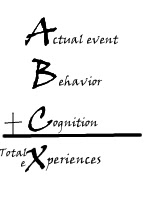 One way to look at it is the ABCX model the picture basically explains it. So the event with how you react to what it makes you think equals your total experiences. This is why we have people within a family that experiences crisis or two families that experiences the same crisis and their experiences is completely different. Part of behavior and cognition is copping patterns. What behavior or thinking do we use in order to help protect ourselves from pain. Many copping mechanisms work in the temporarily, like alcohol, addiction, denial and avoidance. For that day or week or whatever amount of time it works for you, but some of them compound the problem and cause the crisis to be bigger. A good copping pattern is reframing, all you are doing is changing how you think about a situation. Nothing about the actual even changes, just how you are looking at it. Most religious people are good at this. We have something really crappy happen to us and then we look back on it and think that it has changed us for the better. That it helped us have a better relationship or prepared us for something else. However reframing is not saying that because it happened I know I can handle it so at this moment of great need I am going to try and take care of everyone else and ignore all of my negative feelings because I should have those because this is a good experiences. That is called avoidance. I had this problem because I didn't want to be seen a a victim and then people would call me strong and then I would feel hypocritical because I wasn't that strong. What I didn't understand then was that is is alright to be vulnerable and even if an emotion doesn't make sense you can't logical yourself out of it. It is your feeling you need to bridle it, not run away, not beat it to death, not drowned it, but bridle it. It takes practice and work and it helps to talk to other people.
 One way to look at it is the ABCX model the picture basically explains it. So the event with how you react to what it makes you think equals your total experiences. This is why we have people within a family that experiences crisis or two families that experiences the same crisis and their experiences is completely different. Part of behavior and cognition is copping patterns. What behavior or thinking do we use in order to help protect ourselves from pain. Many copping mechanisms work in the temporarily, like alcohol, addiction, denial and avoidance. For that day or week or whatever amount of time it works for you, but some of them compound the problem and cause the crisis to be bigger. A good copping pattern is reframing, all you are doing is changing how you think about a situation. Nothing about the actual even changes, just how you are looking at it. Most religious people are good at this. We have something really crappy happen to us and then we look back on it and think that it has changed us for the better. That it helped us have a better relationship or prepared us for something else. However reframing is not saying that because it happened I know I can handle it so at this moment of great need I am going to try and take care of everyone else and ignore all of my negative feelings because I should have those because this is a good experiences. That is called avoidance. I had this problem because I didn't want to be seen a a victim and then people would call me strong and then I would feel hypocritical because I wasn't that strong. What I didn't understand then was that is is alright to be vulnerable and even if an emotion doesn't make sense you can't logical yourself out of it. It is your feeling you need to bridle it, not run away, not beat it to death, not drowned it, but bridle it. It takes practice and work and it helps to talk to other people.
Subscribe to:
Posts (Atom)